Reactive printing
101–105°CSaturated-steam supply and chamber humidification for moisture uptake and colour development.

LONG LOOP STEAMING SYSTEM
Give printed fabrics the steam, moisture and dwell time they need. Configured around your fabric, dye process and production line.
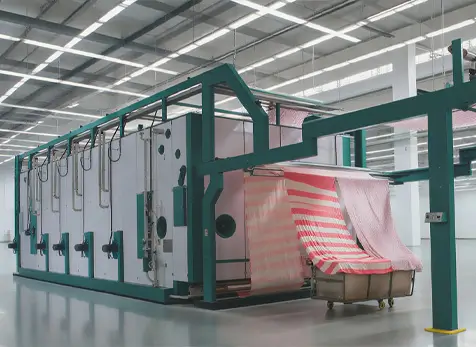
START WITH YOUR PROCESS
Choose the steaming conditions around your dye system. Heating and moisture arrangements are specified to suit the process.
Saturated-steam supply and chamber humidification for moisture uptake and colour development.
Match fabric capacity to the required steaming time and the production rate of your line.
High-temperature heating with circulation along the steaming chamber.
Temperature and moisture control selected around your discharge-printing recipe.
Reference process temperatures. Final settings depend on the fabric, dyes and recipe. Multiple processes require the appropriate machine configuration.
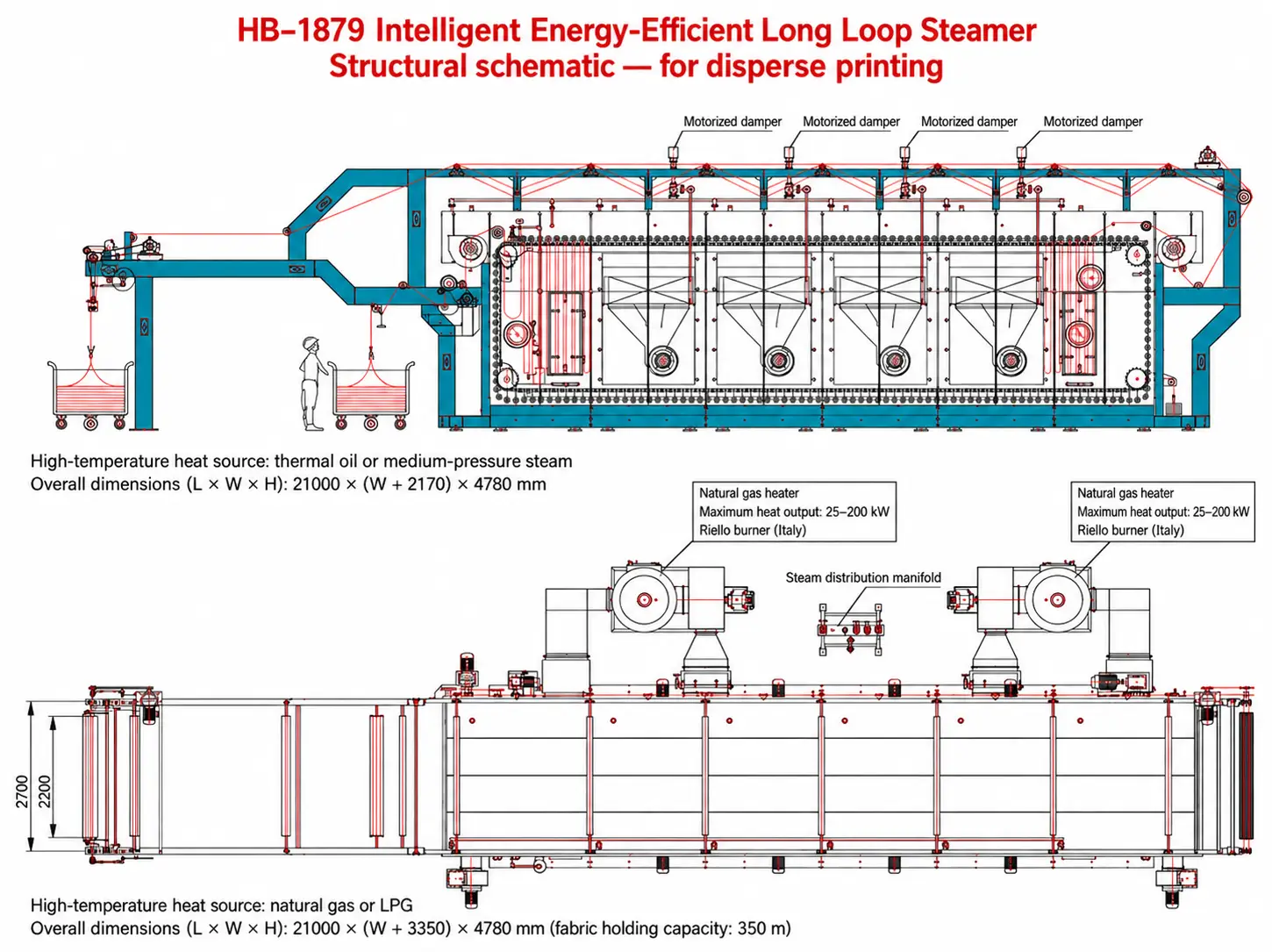
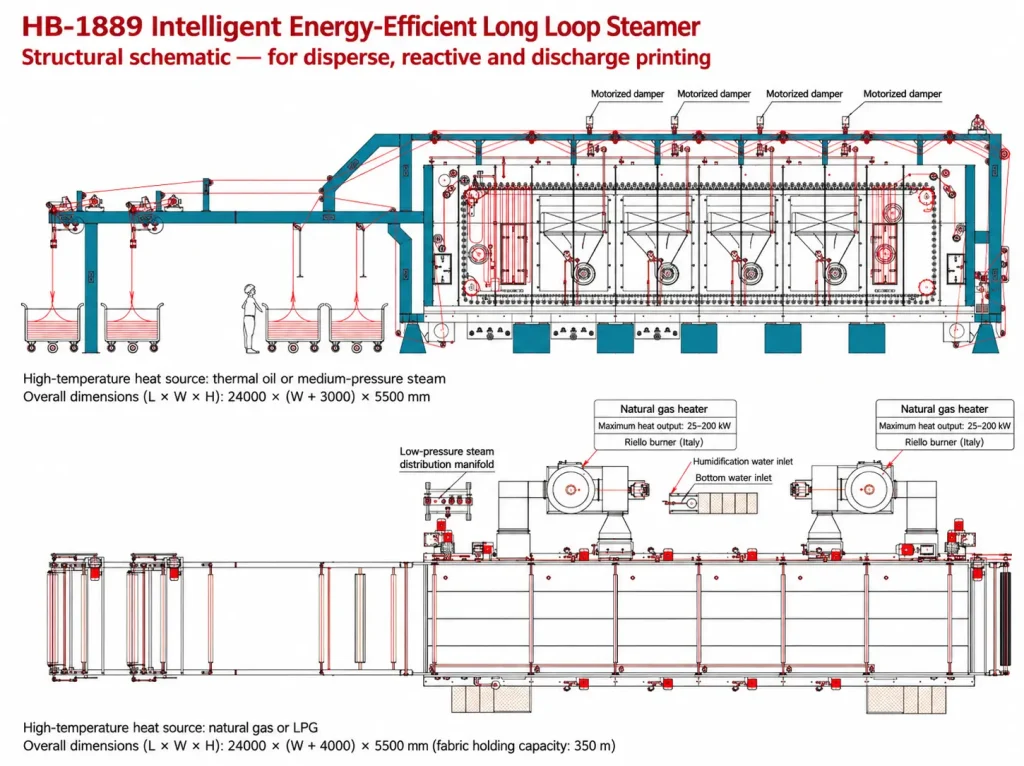
INSIDE THE MACHINE
Temperature is only part of the process. Moisture, circulation and fabric support all deserve a closer look.
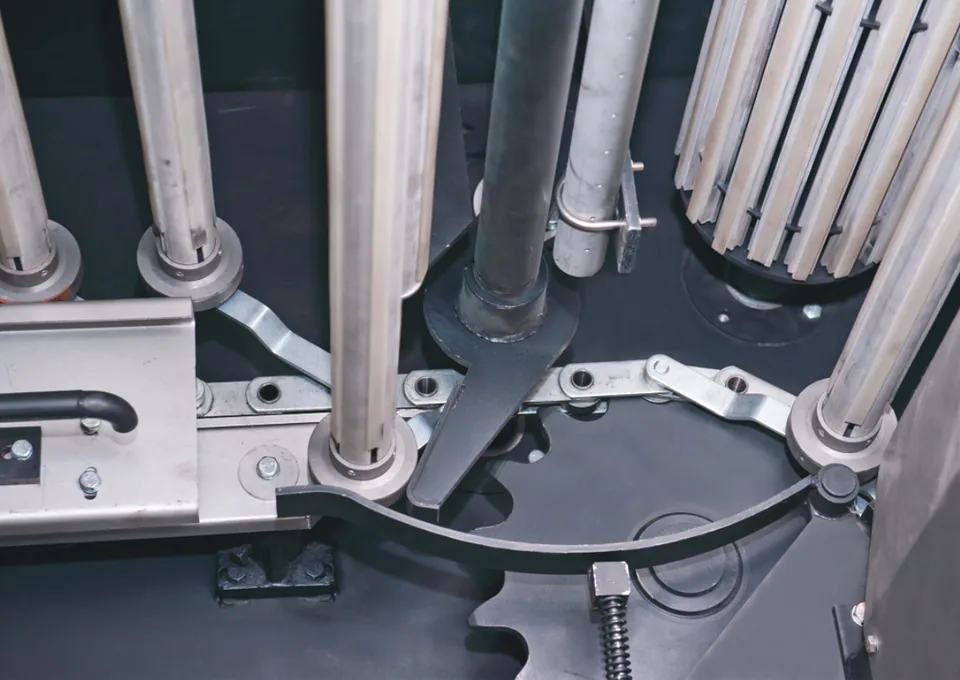
Steam is applied directly at the feed and loop-forming point, helping the incoming fabric take up moisture while supporting stable loop formation.
An additional saturated-steam supply sits beneath this area. Inside the chamber, steam-assisted atomisation and circulation fans distribute moisture through the treatment environment.
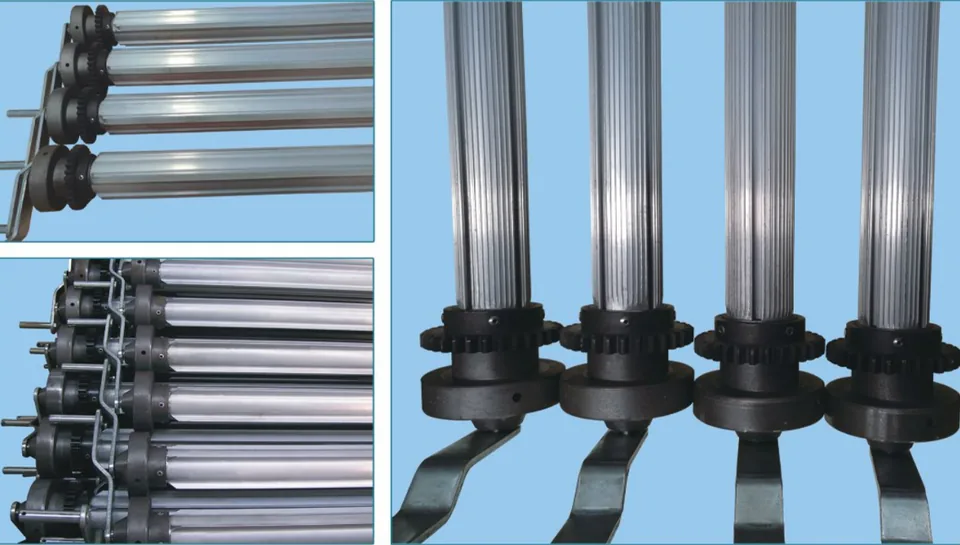
Ø50 mm hanging rollers rotate as they travel along the rails, helping limit transverse support marks during steaming.
Choose rubber-strip, four-wing or fine-toothed rollers according to the fabric and process. Adjustable loop length gives another way to set up the machine for the fabric you run.
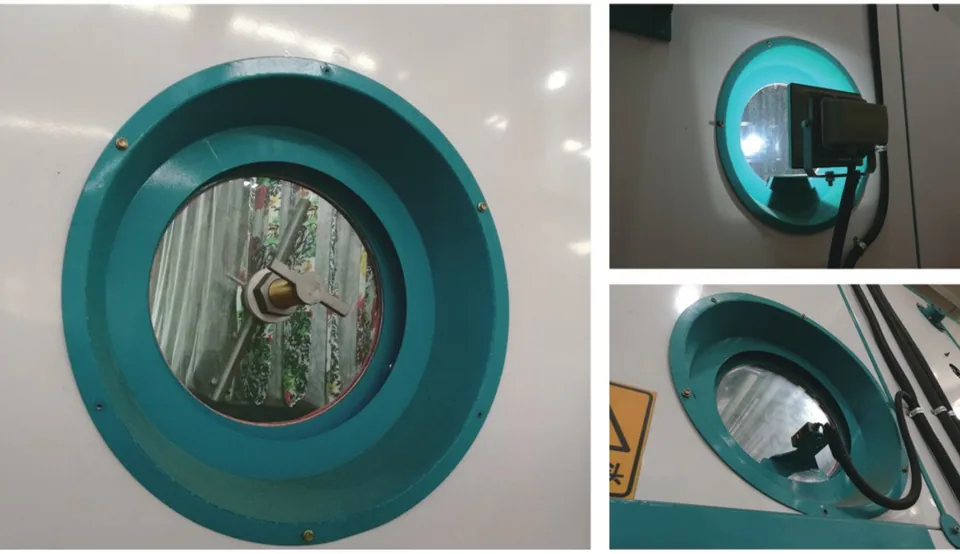
Illuminated observation windows give operators a view into the chamber. A fabric-capacity detector works with the outlet speed-control arrangement to manage discharge.
The humidification assembly is designed for removal and nozzle cleaning, making blocked nozzles easier to access during maintenance.
CONFIGURED FOR YOUR MILL
Specify the heating system, chamber materials and fabric arrangement together. Each choice should fit your process and your site.
The gas-heated arrangement uses two heating units for the front and rear sections. Thermal oil and medium-pressure steam are alternative high-temperature heat sources.
Discuss your heat source ↗Each 70 m intermediate section includes two circulation fans, two heat exchangers and two sets of steam humidification nozzles.
Review machine capacity ↗09CuPNiCr-A weathering steel or SUS316L stainless steel is available for the chamber and steam-circulation components. Confirm the material scope in your quotation.
Ask about material options ↗THE TECHNICAL DETAILS
Choose the working arrangement around your fabric width, required steaming time and available utilities.
Left-hand and right-hand drive arrangements are available, viewed from the fabric entry.
Discuss specifications ↗| Specification | Range / options |
|---|---|
| Machine width | 1,800–4,000 mm |
| Fabric capacity | 140 / 210 / 280 / 350 / 420 m |
| Loop length | 1.25–2.5 m · adjustment ratio 1:2 |
| Mechanical speed | 5–80 m/min |
| Main fabrics | Knitted and woven printed fabrics |
| Fabric entry / exit | Front/front or rear/rear |
| Running arrangements | Single-layer/single-width or double-layer/double-width |
| Minimum steam pressure | 0.3 MPa |
| Maximum supply water temperature | 60°C |
| High-temperature heat source | Thermal oil, medium-pressure steam or natural gas |
Specifications vary with configuration. Confirm usable fabric width separately from machine width. Mechanical speed is not a production-output guarantee.
A simple example with 350 m of fabric in the steaming path and a 10-minute dwell time. Actual operation depends on usable capacity, fabric behaviour and process conditions.
BEFORE YOU ENQUIRE
Have a specific fabric or process in mind?
Include it in your enquiry.
The range offers configurations for reactive, acid, disperse and discharge printing. Specify every process you need at the quotation stage so the heating and steam systems can be selected accordingly.
Start with the required steaming time and target line speed. These determine how much fabric needs to remain inside the chamber during treatment. Installation space is another part of the decision.
Natural gas, thermal oil and medium-pressure steam are available for high-temperature configurations. Share your operating temperature and existing utilities to compare suitable arrangements.
The published reference figures apply to a 3,600 mm-wide machine with 350 m fabric capacity under specified process conditions. Request figures for the configuration and recipe you plan to run.
Pigment-print baking is listed as an application. The heating configuration and curing conditions need to be confirmed for your specific process.
Fabric construction and composition, fabric width, dye process, required steaming time and target output. Details of the available heat source and floor space will help narrow down the configuration.